Turn a Holiday-Provision Update Into Three Team Questions
Filed under: Practice Notes
A team discussion about holiday provision can become a tour of inspection terminology while leaving the setting itself barely described. Begin somewhere more useful: what would a colleague need to understand about this particular provision?
In its May 21, 2026 post about holiday providers, Ofsted explained the place of setting context in its approach. The post also discussed what providers intend children to gain from activities and how children’s views inform planning. These are the starting points for the optional discussion below, rather than a summary of current inspection requirements in England.
1. What is particular about this provision?
Ask a colleague to describe the pattern of provision without using an inspection grade: when it operates, which age groups it serves and what the team knows about children who attend for a short period. Use a fictional setting for training, or discuss a general description without identifiable child information.
Notice where the description becomes uncertain. Does “holiday club” mean the same operating pattern to everyone in the room? Is an example about a familiar returning group being used to describe every session? A useful outcome is one clearly worded question about context that needs checking.
2. What is the purpose of one activity?
Choose a hypothetical activity, such as a shared construction challenge. Ask what children might gain from taking part and what choices the activity leaves open. Avoid jumping from the activity’s name to a claim that a particular outcome has happened.
For example, “children can choose materials and negotiate a shared design” describes an opportunity. “Every child becomes confident” claims an outcome that the description alone cannot establish. Discuss what an adult would need to notice before drawing a more specific conclusion. Keep any imagined response in this training example distinct from an observation that has actually been made.
This is a way to examine the explanation of an activity, not an instruction to assemble evidence for an imagined inspector.
3. Where could children’s views alter the plan?
Stay with the same example. Which parts could children influence: the materials, the grouping, the pace or whether to take part? If the proposed method is a spoken group question, consider who might find that format difficult to use.
The discussion does not need to prescribe one consultation method. Its purpose is to distinguish offering a choice from assuming that a visible response represents everyone’s view.
Follow one activity through all three questions
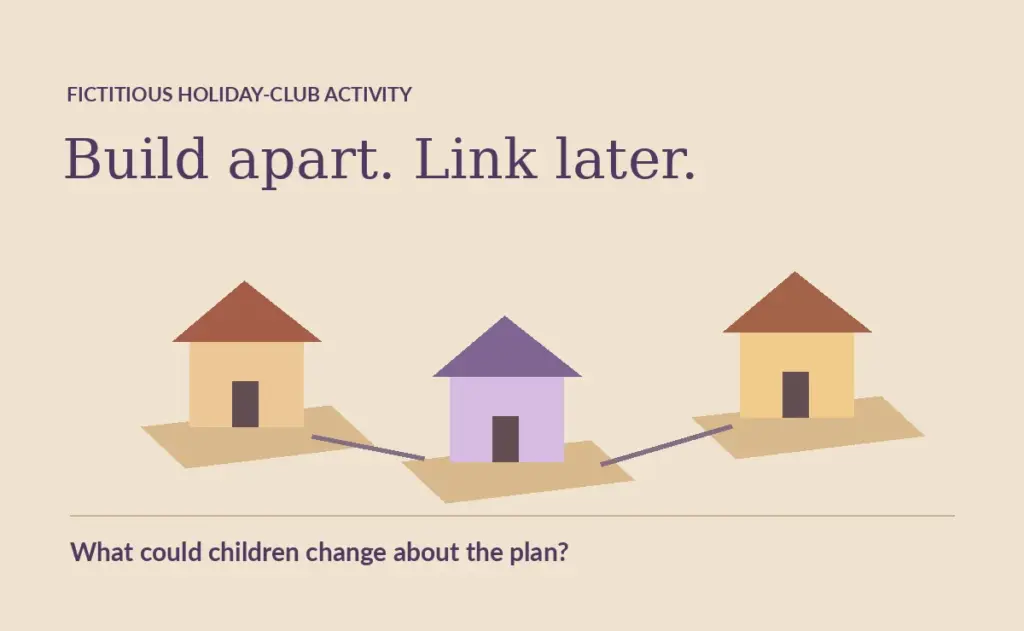
Here is a wholly fictional team discussion. A holiday club is planning a shared model town using materials selected by its staff. Some children have attended before; others are new. The team initially describes the activity as “working together”, but that phrase leaves the three questions unanswered.
Context changes the starting point. Returning children may know the materials and each other. That does not tell staff what a newcomer understands about joining in. The team adds a simple introduction to the activity and leaves room for someone to explore a smaller construction before joining the shared town. These are proposed choices, not evidence that every child now feels included.
Purpose changes what the team notices. If the intended opportunity is to negotiate a shared design, a finished model is not enough to show how decisions happened. Staff would need to notice whose ideas shaped it, whether a disagreement could be resolved and whether someone had a way to contribute without addressing the whole group. Those observations could qualify the original explanation of “working together”.
A view changes the plan only if something can move. Imagine that children suggest building separate places and connecting them later. The team could adapt the grouping and order of the activity while retaining the shared-design opportunity. It should also leave a route for children who have not spoken to express a preference. Agreement from the most vocal children would not answer that question.
The resulting note is concrete: “Try the separate-build option; notice how children join the later linking stage; ask which parts they would keep or change.” A named colleague can bring that account back to the next discussion. The note commits the team to checking an opportunity, not to reporting a success before the activity happens.
Finish with a small, testable next step
Keep three short notes: the context question, the activity explanation that needs sharpening and the proposed way of hearing a wider range of views. Give the next check an owner, an agreed review date and a clear question to bring back.
Do not turn the notes into a verdict on the provision. Applicability, legal duties and inspection procedures need to be checked against the relevant official early years inspection materials. A staff conversation is most useful when it makes the setting easier to describe and the remaining questions easier to locate.