An Assistant Handover Starts With a Clear Role Description
Filed under: Practice Notes
“Help with the morning” sounds like a role description until two colleagues interpret it differently. One may mean preparing resources; another may assume responsibility for a much wider part of the session. A handover needs a more precise starting point.
Ofsted’s May 18, 2026 article on childminder assistants distinguishes the childminder’s role from the assistant’s and discusses suitability checks. That England-specific source provides context for this optional role-clarity exercise. The exercise cannot grant permission to undertake childcare duties or replace a suitability decision.
Describe a task before describing a person
Start with an invented administrative task: preparing a resource cupboard list for a future session. Keep actual children, families and staff records out of the training example.
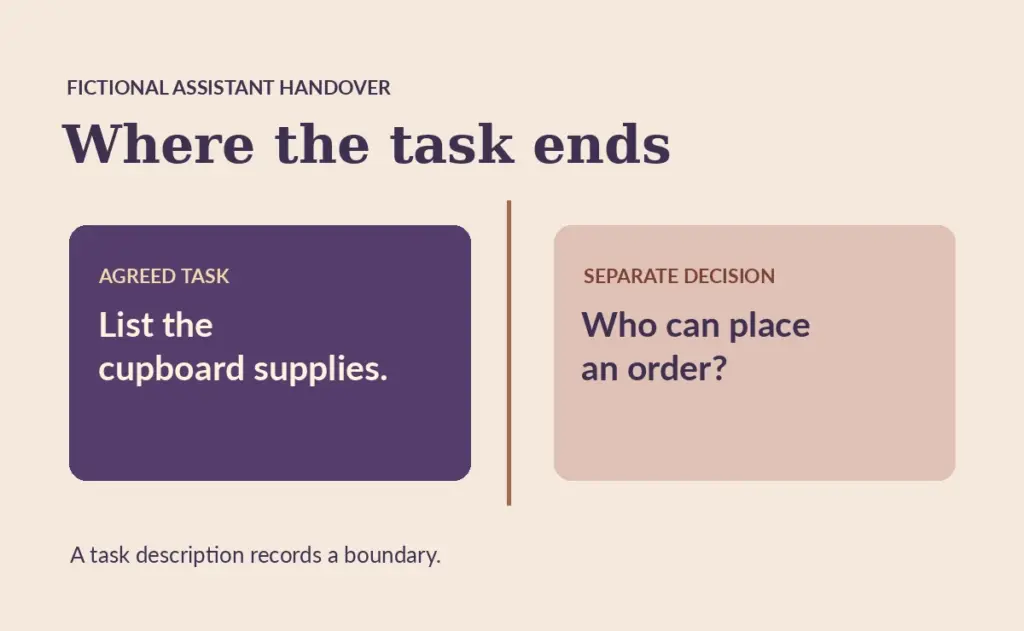
Write the task in one sentence that identifies an action and an endpoint: “List the materials in the marked cupboard and flag items needing a decision.” This gives a colleague something concrete to discuss. “Be proactive with resources” leaves both the boundary and the expected result open.
Then ask what falls outside the task. The person making the list might identify a proposed purchase, for example, without being the person who authorises spending. A handover should not quietly turn a reporting task into a decision-making role.
Make the handover answer three questions
- What is agreed? State the task, its limits and the dated record where that agreement is held.
- What needs checking? Keep assumptions visible instead of writing them as settled instructions.
- Where does an unresolved question go? Identify the existing role or process responsible for the next decision, including the established cover route if that person is unavailable.
Ask a colleague to explain the handover back in their own words. If the account adds a responsibility that was never agreed, return to the wording. The point is to find the ambiguity before the task is used.
Keep agreement and authorisation distinct
Before an assistant takes on a real duty, the responsible childminder checks the applicable requirements through the current official process. Keep agreed duties in the handover and personal application details in the appropriate confidential record.
Close the loop when the task changes
Suppose the invented cupboard task expands to include placing an order. Ask the group what new decision is required, who owns it and which description would need updating. Keep the expanded task as a proposal until the relevant agreement exists.
Ask the next colleague to name the task, its limit and who can resolve an open question. For an actual assistant arrangement in England, open the Ofsted article and follow the current guidance it links.