
Check fit before format
Write the question and one learning aim before comparing a webinar, reading group, mentoring conversation or longer course. Ask what you need to understand or be able to explain afterwards. A short text can be enough for an initial question; a change requiring supervised skills may need sustained support.
Look for a named provider, a current syllabus or description, intended participants, teaching language, duration and a contact for questions. Check the author’s or tutor’s relevant background at the source. Testimonials do not establish either accreditation or suitability.
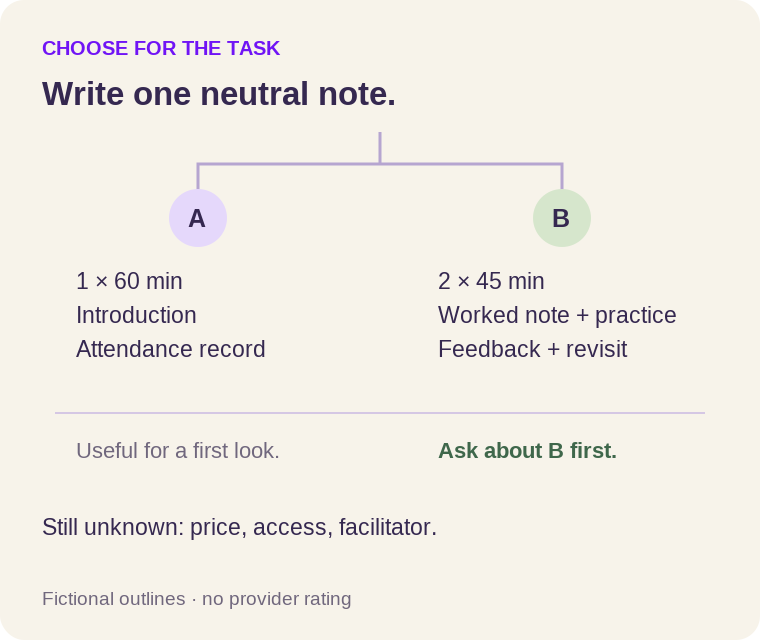
Choose for the task
Write one neutral note.
1 × 60 min
Introduction
Attendance record
Useful for a first look.
2 × 45 min
Worked note + practice
Feedback + revisit
Ask about B first.
Still unknown: price, access, facilitator.
Fictional outlines · no provider rating
Questions to ask before committing
- Relevance: which part of my question does the programme address, and which part is outside its scope?
- Evidence: can I inspect an outline, sample or source list rather than only promotional claims?
- Access: are language, timing, materials and accessibility arrangements workable?
- Support: is there time to discuss, practise and receive feedback in an appropriate setting?
- Transfer: what team agreement or resources would be needed to use the learning?
- Recognition: if accreditation or credit is required, can the relevant body confirm the current programme and period?
- Cost: what are the full price, cancellation terms and expected time commitment?
Two invented options, one stated learning aim
Fictional comparison, not real providers or course recommendations. A staff team wants to distinguish description from interpretation in its own meeting notes. The immediate aim is to produce one neutral sample note and explain the difference.
- Option A: a one-hour talk
- Includes an introduction and attendance certificate. The supplied outline gives no worked note, rehearsal or feedback. It could introduce vocabulary; it does not yet show how the team would practise the target task.
- Option B: two 45-minute workshops
- In this invented outline, adults compare two notes, write their own fictional example, receive peer feedback and revisit it one week later. Total scheduled time is 90 minutes; preparation time and price remain unknown.
- Evidence checked
- Only the two fictional outlines above. No accreditation, tutor credentials or participant outcomes have been checked.
- Decision
- Ask about B’s sample material, facilitator, full cost and accessible format. Prefer B for this skill aim if those checks are satisfactory and staff time is agreed. Choose A only if the current need is a first introduction; defer both if no suitable time or support is available.
- Afterwards
- Review the sample note against the learning aim. Attendance and enjoyment would not establish improved practice, and neither would prove an effect on children.
The choice follows the work to be learned. More minutes alone do not make B better; rehearsal, feedback and a revisit are the relevant differences in this constructed example.
Make the choice explicit
Working sheet: professional-learning choice
Use non-identifying notes. Copy your work before leaving, or print this page.
After the activity, record learning separately
Keep attendance evidence where your institution requires it. Separately, write what you learned, which source supports it and what you still do not understand. If you plan a change, agree it through the normal channels and set a review point. Do not turn a positive reaction to a course into a claim of improved outcomes.
Continue with the learning-cycle plan. For historical KEY-related courses or certificates, approach the relevant institution; this edition has no enrolment or verification service.
The source behind our questions
Collin and Smith, EEF (2021), Effective Professional Development, printed pp. 22, 25 and 30–33, discusses rehearsal and feedback, action planning, self-monitoring and conditions for implementation. We used those mechanisms to ask what happens after a presentation.
The seven-question checklist adds our own practical checks on language, cost, recognition and access. It is an editorial synthesis, not an EEF rating scale or a validated measure of course quality.