Check fit before format
Write the question and one learning aim before comparing a webinar, reading group, mentoring conversation or longer course. Ask what you need to understand or be able to explain afterwards. A short text can be enough for an initial question; a change requiring supervised skills may need sustained support.
Look for a named provider, a current syllabus or description, intended participants, teaching language, duration and a contact for questions. Check the author’s or tutor’s relevant background at the source. Testimonials do not establish either accreditation or suitability.
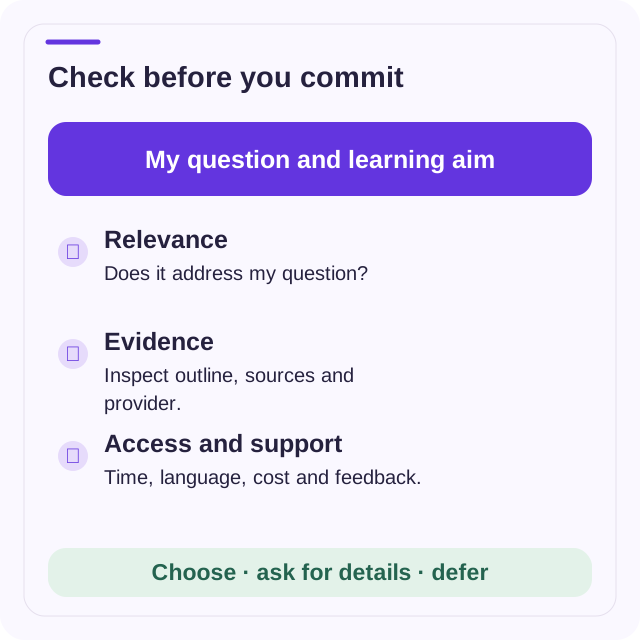
Questions to ask before committing
- Relevance: which part of my question does the programme address, and which part is outside its scope?
- Evidence: can I inspect an outline, sample or source list rather than only promotional claims?
- Access: are language, timing, materials and accessibility arrangements workable?
- Support: is there time to discuss, practise and receive feedback in an appropriate setting?
- Transfer: what team agreement or resources would be needed to use the learning?
- Recognition: if accreditation or credit is required, can the relevant body confirm the current programme and period?
- Cost: what are the full price, cancellation terms and expected time commitment?
Make the choice explicit
Working sheet: professional-learning choice
Write here, then print or copy your notes. Entries stay in this tab and are not sent or saved by this page. Copy them before leaving.
After the activity, record learning separately
Keep attendance evidence where your institution requires it. Separately, write what you learned, which source supports it and what you still do not understand. If you plan a change, agree it through the normal channels and set a review point. Do not turn a positive reaction to a course into a claim of improved outcomes.
Continue with the learning-cycle plan. For historical KEY-related courses or certificates, approach the relevant institution; this edition has no enrolment or verification service.