
Start with a question you can act on
A broad aim such as “improve communication” is hard to review. Narrow it to one part of your own work: how you explain an activity to colleagues, prepare an invitation for families, or organise your planning notes. Avoid starting with a conclusion about a child or a family.
Try this form: “What do I need to understand about ___ before I decide whether to change ___?” State what is within your role, what needs team agreement and when you will review it. If the question needs specialist advice, use your institution’s professional channels.
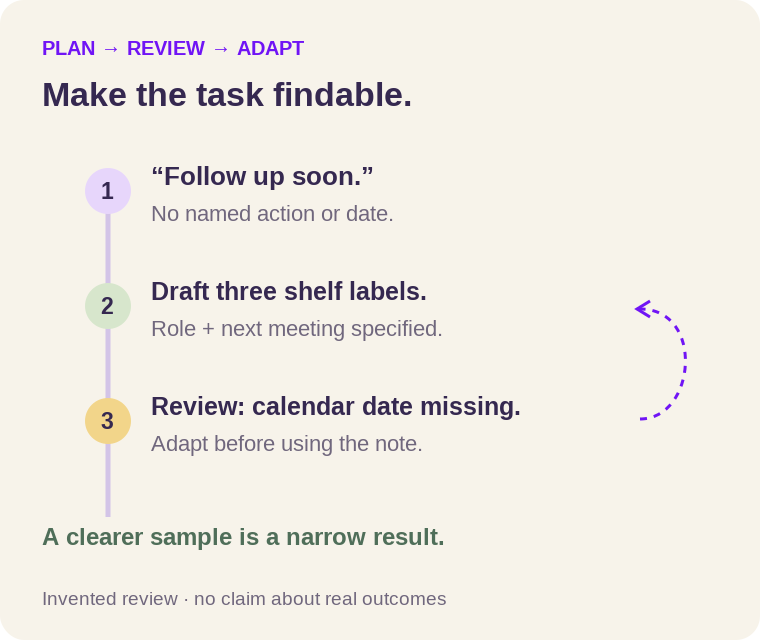
Plan → review → adapt
Make the task findable.
“Follow up soon.”
No named action or date.
Draft three shelf labels.
Role + next meeting specified.
Review: calendar date missing.
Adapt before using the note.
A clearer sample is a narrow result.
Invented review · no claim about real outcomes
Follow four linked steps
Observe a starting point
Describe one routine in neutral language. Record context and an adult action you can revisit. Do not collect personal data merely because a worksheet has space.
Choose one learning input
Read a chapter, discuss a source with a colleague or select a relevant course. Note the author, date, claim and limits. Explain what the input helps you understand.
Plan one modest adjustment
Write the intended adult action and why it fits the question. Agree any required permissions and a review date. Keep necessary support in place.
Review and decide
Compare your notes with your starting question. Record unexpected effects, alternative explanations and what remains unknown. Choose to keep, adapt, stop or seek advice; a completed sheet does not prove effectiveness.
Use a blank plan
Working sheet: one question, one cycle
Use non-identifying notes. Copy your work before leaving, or print this page.
Download the blank plan as plain text. Keep completed notes in your institution’s approved storage; this site does not store them.
A completed cycle: make one action findable
Entirely invented adult planning exercise. The review below is part of the example, not a field report.
- Question
- Can a colleague find the agreed task and review date in our sample staff handover note without asking its author?
- Starting point
- The fictional note says: “Resources discussed; follow up soon.” It names neither an action nor a date.
- Learning input
- Read EEF’s account of action planning and self-monitoring, then agree that a usable task line needs an action, responsible role and review date.
- Plan
- Replace the line with: “Resource coordinator: draft three shelf labels before the next team meeting; team to review the draft at that meeting.” Ask a colleague to locate the task and review point. Use sample documents only.
- Illustrative review
- The colleague can point to the task and review occasion, but the text still lacks a calendar date. That is a remaining ambiguity, not a successful implementation claim.
- Decision
- Adapt: add an agreed date before using the note. Keep the action/role/review structure. Stop adding fields if they do not help the decision; seek team agreement before changing an institutional form.
The exercise supports a narrow conclusion: this version makes particular information explicit. It says nothing about whether a real team acted, whether work improved or whether children benefited.
Continue with observation notes or choosing professional learning.
Where the four steps come from
EEF (2021), printed pp. 24–25, discusses action plans, reminders, monitoring and repetition as support for embedding practice. Our four-step cycle is a short editorial arrangement; it is not a cycle prescribed or tested by EEF.
Elizabeth Yardley, chapter 8 in the KEY guidance (2022), printed pp. 64–68, begins with identifying learners and their needs, then discusses question design and piloting. We take the principle of checking the question with its intended reader. We do not turn this personal planning sheet into a survey or an evaluation study.