
Outputs described in the project publication
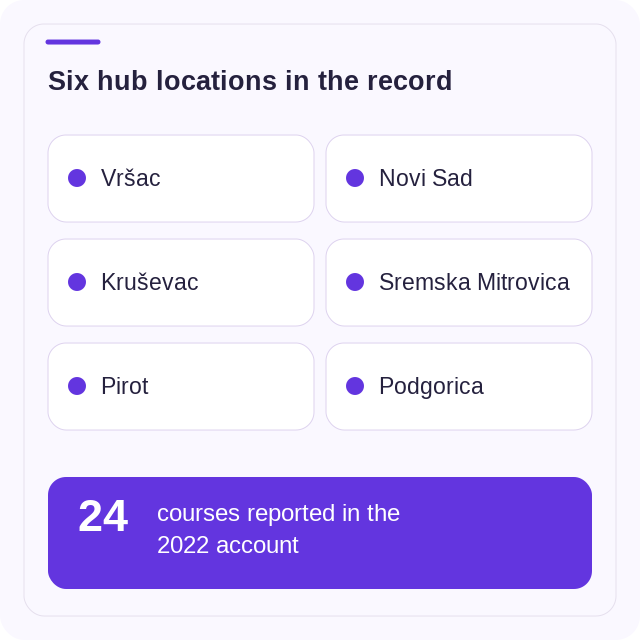
Chapter 1 of the 2022 guidance, printed pages 15–18 describes learning hubs in six participating higher-education locations: Vršac, Novi Sad, Kruševac, Sremska Mitrovica, Pirot and Podgorica. It also describes course development and work on monitoring, evaluation and accreditation models.
These are statements in the project’s own retrospective account. They are not a current course catalogue or an independent impact audit. For a present-day course, platform login, accreditation status or replacement certificate, the responsible institution is the appropriate contact.
A publication available to read
The quality-and-evaluation guidance is preserved in Birmingham City University’s repository. Its contents discuss stakeholder voices, theory-of-change processes and choices among evaluation methods. The repository provides a concrete place to inspect the publication, distinct from a website’s general claim that a project produced results.
Publication details and access. The earlier comparative study is separately identified in the comparative study record.
Questions for judging an output
- What exactly was produced: a course, a centre, a guideline or a model?
- Who reports it, and from what date? Is the underlying material accessible?
- Does the source measure a participant’s learning, a change in practice or a wider effect?
- What baseline, comparison or follow-up would be needed to support a stronger claim?
- Does the description still apply now, or only to the project period?
Our observation guide uses the same distinction between description and interpretation. It is an editorial practice tool, not a project evaluation finding.
One work package, three different claims
Chapter 1, printed p. 16, reports that 24 courses were created in WP3, describes their accreditation through the normal bodies in Serbia and Montenegro, and says courses were offered through regional training sessions.
- Intention
- Develop CPD through learning hubs and Moodle-related work.
- Reported delivery
- The project authors report 24 created courses. This is a count of materials in their retrospective account, not a count of people who learned.
- What it cannot establish
- The page does not supply a comparison showing lasting changes in participants’ practice or children’s outcomes. Nor does it identify a currently open enrolment offer.