Outputs described in the project publication
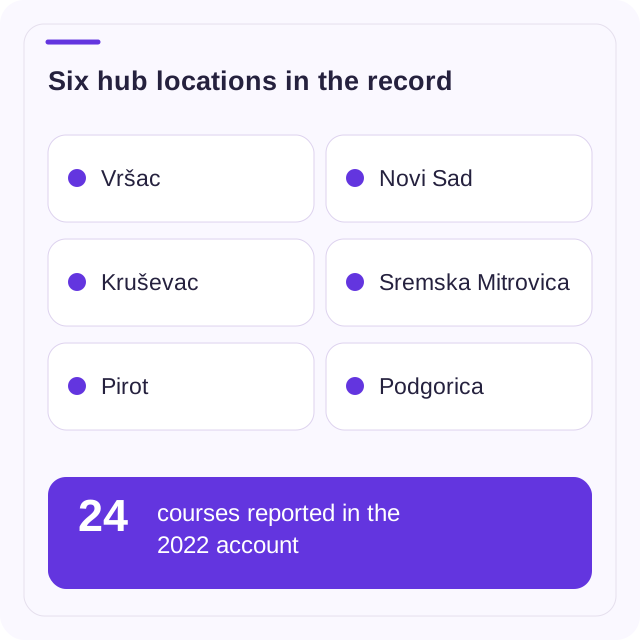
Chapter 1 of the 2022 guidance, printed pages 15–18 describes learning hubs in six participating higher-education locations: Vršac, Novi Sad, Kruševac, Sremska Mitrovica, Pirot and Podgorica. It also reports development of 24 courses within the Moodle-related work package and work on monitoring, evaluation and accreditation models.
These are statements in the project’s own retrospective account. They are not a current course catalogue or an independent impact audit. For a present-day course, platform login, accreditation status or replacement certificate, the responsible institution is the appropriate contact.
A publication available to read
The quality-and-evaluation guidance is preserved in Birmingham City University’s repository. Its contents discuss stakeholder voices, theory-of-change processes and choices among evaluation methods. The repository provides a concrete place to inspect the publication, distinct from a website’s general claim that a project produced results.
Publication details and access. The earlier comparative study is separately identified in the comparative study record.
Questions for judging an output
- What exactly was produced: a course, a centre, a guideline or a model?
- Who reports it, and from what date? Is the underlying material accessible?
- Does the source measure a participant’s learning, a change in practice or a wider effect?
- What baseline, comparison or follow-up would be needed to support a stronger claim?
- Does the description still apply now, or only to the project period?
Our observation guide uses the same distinction between description and interpretation. It is an editorial practice tool, not a project evaluation finding.